
We would like to thank Crown Family Philanthropies and the Abe and Ida Cooper Foundation for supporting the ongoing work to create content and resources for the Holocaust Encyclopedia. View the list of all donors.
Article sélectionné
Introduction à la Shoah
La Shoah désigne la persécution et l'extermination systématiques et cautionnées par l'État de 6 millions de Juifs d'Europe par le régime allemand nazi, ses alliés et ses collaborateurs. Elle constitue un processus graduel qui s'est déroulé à travers l'Europe entre 1933 et 1945.
À lire
-
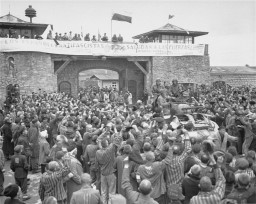
![Mauthausen survivors cheer the soldiers of the Eleventh Armored Division of the US Third Army one day after their liberation]()
Article
La libération des camps -
![German soldiers direct artillery against a pocket of resistance during the Warsaw ghetto uprising. [LCID: 34083b]]()
Article
Le soulèvement du ghetto de Varsovie -
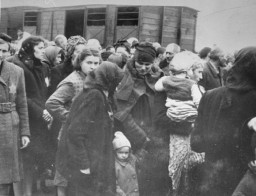
![Jews from Subcarpathian Rus get off the deportation train and assemble on the ramp at Auschwitz-Birkenau. May 1944.]()
Article
Introduction à la Shoah -
![Deportation of Jewish women from the Warsaw ghetto. [LCID: 60566]]()
Article
Victimes de l'époque nazie : l'idéologie raciale nazie -
![Deportation of Romani (Gypsy) families from Vienna to Poland. [LCID: 22005]]()
Article
Le génocide des Tsiganes européens, 1939-1945 -
![At a rally, members of the Hitler Youth parade in the formation of a swastika to honor the Unknown Soldier. [LCID: 85513]]()
Article
Histoire de la croix gammée -
![Storefronts of Jewish-owned businesses damaged during the Kristallnacht ("Night of Broken Glass") pogrom. [LCID: 4315]]()
Article
La Nuit de cristal (9-10 novembre 1938) -
![Hitler rehearsing his oratory. Hitler carefully cultivated his image as the Nazi Party leader as he came to see the propagandistic ... [LCID: p509]]()
Article
L'arrivée au pouvoir des Nazis -
![British soldiers transfer Jewish refugee children from the ship Theodor Herzl]()
Article
La crise des réfugiés après la guerre et la création de l'Etat d'Israël
![German soldiers direct artillery against a pocket of resistance during the Warsaw ghetto uprising. [LCID: 34083b]](https://encyclopedia.ushmm.org/images/thumb/8ffe37b4-0b4f-4966-9e03-838766fb9e89.jpg)
![Deportation of Jewish women from the Warsaw ghetto. [LCID: 60566]](https://encyclopedia.ushmm.org/images/thumb/13349d6f-20f3-454c-bc1a-8ffb19df74dd.jpg)
![Deportation of Romani (Gypsy) families from Vienna to Poland. [LCID: 22005]](https://encyclopedia.ushmm.org/images/thumb/bd14360a-6cc2-4b64-8c68-32430f2350ee.jpg)
![At a rally, members of the Hitler Youth parade in the formation of a swastika to honor the Unknown Soldier. [LCID: 85513]](https://encyclopedia.ushmm.org/images/thumb/cdadf487-50d7-4b0c-a912-ce6d9001f52a.jpg)
![Storefronts of Jewish-owned businesses damaged during the Kristallnacht ("Night of Broken Glass") pogrom. [LCID: 4315]](https://encyclopedia.ushmm.org/images/thumb/ed400cf5-3397-4a1f-8cec-2ece2e7a90e7.jpg)
![Hitler rehearsing his oratory. Hitler carefully cultivated his image as the Nazi Party leader as he came to see the propagandistic ... [LCID: p509]](https://encyclopedia.ushmm.org/images/thumb/e22beaab-692b-4db6-84a7-d7d715632f1d.jpg)
Explorer l'Encyclopédie
Cartes d'identité
Explorer les cartes d'identité pour en savoir plus sur des parcours personnels au cours de l'Holocauste
Photographies
Parcourir toutes les photographies
Mots-clés
Trouver des thèmes d'intérêt et explorer des contenus qui s'y rapportent dans l'Encyclopédie