
We would like to thank Crown Family Philanthropies and the Abe and Ida Cooper Foundation for supporting the ongoing work to create content and resources for the Holocaust Encyclopedia. View the list of all donors.
Artículo Destacado
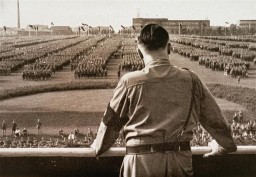
Adolf Hitler
Adolf Hitler fue el líder indiscutido del Partido Nacionalsocialista Obrero Alemán, conocido como nazi, desde 1921. En 1923 fue detenido y encarcelado por intentar derrocar al gobierno alemán. Su juicio lo volvió famoso y le consiguió seguidores. Hitler aprovechó el tiempo que pasó en prisión para plasmar sus ideas políticas en un libro titulado Mein Kampf (Mi lucha). Las metas ideológicas de Hitler eran la expansión territorial, la consolidación de un estado racialmente puro y la eliminación de los judíos europeos y de otros a quienes se percibía como enemigos de Alemania.
Navegar artículos populares
-
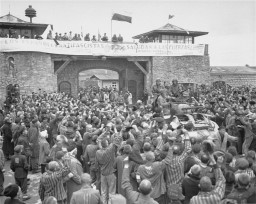
![Mauthausen survivors cheer the soldiers of the Eleventh Armored Division of the US Third Army one day after their liberation]()
Artículo
La liberación de los campos nazis -
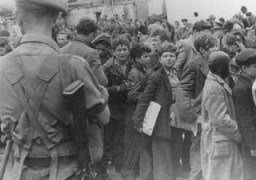
![British soldiers transfer Jewish refugee children from the ship Theodor Herzl]()
Artículo
Los sobrevivientes del Holocausto y la fundación del estado de Israel (14 de mayo de 1948) -
![Stretcher bearers carry a wounded soldier during the Battle of the Somme. [LCID: 2453747]]()
Artículo
Primera Guerra Mundial -
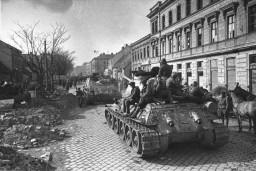
![Soviet tanks roll down a street in Vienna]()
Artículo
La Segunda Guerra Mundial en Europa (versión abreviada) -
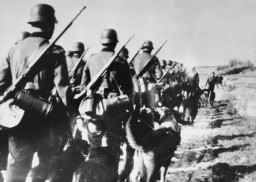
![German troops on the move during an anti-partisan operation.]()
Artículo
La Segunda Guerra Mundial a profundidad -
![German forces enter Aachen, on the border with Belgium, following the remilitarization of the Rhineland. [LCID: 70032]]()
Artículo
Cronología de la Segunda Guerra Mundial -
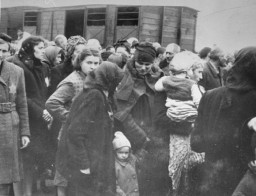
![Jews from Subcarpathian Rus get off the deportation train and assemble on the ramp at Auschwitz-Birkenau. May 1944.]()
Artículo
Introducción al Holocausto -
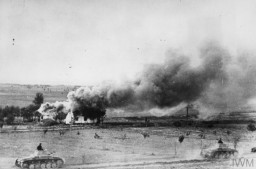
![German tanks on the eastern front © IWM (HU 111382)]()
Artículo
La Segunda Guerra Mundial en Europa -
![Adolf Hitler addresses an SA rally, Dortmund, Germany, 1933]()
Artículo
Adolf Hitler
![Stretcher bearers carry a wounded soldier during the Battle of the Somme. [LCID: 2453747]](https://encyclopedia.ushmm.org/images/thumb/647ba4e2-8fc6-4340-9d0c-21dd535eaf42.jpg)
![German forces enter Aachen, on the border with Belgium, following the remilitarization of the Rhineland. [LCID: 70032]](https://encyclopedia.ushmm.org/images/thumb/4d587734-0984-4f9f-9d7d-5e2b5e87dacc.jpg)
Explorar la enciclopedia
Historias personales
Explore las biografías en línea para aprender más acerca de las experiencias personales durante el Holocausto
Fotografías
Navegar todas las fotografías
El Holocausto
Un sitio de aprendizaje para estudiantes