
We would like to thank Crown Family Philanthropies and the Abe and Ida Cooper Foundation for supporting the ongoing work to create content and resources for the Holocaust Encyclopedia. View the list of all donors.
Featured Article
Boycott of Jewish Businesses
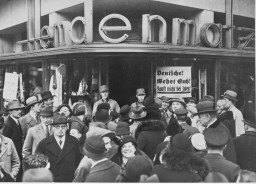
After Adolf Hitler came to power in Germany on January 30, 1933, the Nazi leadership decided to stage an economic boycott against the Jews of Germany. Local Nazi party chiefs organized the national boycott operation. Although it lasted only one day and was ignored by many individual Germans who continued to shop in Jewish-owned stores, it marked the beginning of a nationwide campaign by the Nazi Party against the entire German Jewish population.
![German soldiers direct artillery against a pocket of resistance during the Warsaw ghetto uprising. [LCID: 34083b]](https://encyclopedia.ushmm.org/images/thumb/8ffe37b4-0b4f-4966-9e03-838766fb9e89.jpg)
![SS troops advance during the invasion of Greece. The invasion of the Balkans began in April 1941. [LCID: 20390]](https://encyclopedia.ushmm.org/images/thumb/32fa216d-f273-4760-9c01-099e4c03dcd1.jpg)
![Jews from Macedonia who were rounded up and assembled in the Tobacco Monopoly transit camp before deportation to the Treblinka killing ... [LCID: 79737]](https://encyclopedia.ushmm.org/images/thumb/f2c4528d-d346-46d8-a20c-1cde912c2078.jpg)
![Illustration from an antisemitic children's primer. [LCID: 10640c]](https://encyclopedia.ushmm.org/images/thumb/4c6348d1-d3e6-4be3-aae5-b12761f4f20a.jpg)
![Chief Prosecutor Benjamin Ferencz presents evidence during the Einsatzgruppen Trial. [LCID: 09918]](https://encyclopedia.ushmm.org/images/thumb/b8542ad8-3e73-4b7c-a368-2dcbc971fa85.jpg)

Explore the Encyclopedia
ID Cards
Learn more about personal experiences during the Holocaust
Timeline of Events
Explore a timeline of events that occurred before, during, and after the Holocaust.
Discussion Questions
How and why was the Holocaust possible?