Photo
Browse an alphabetical list of photographs. These historical images portray people, places, and events before, during, and after World War II and the Holocaust.
<< Previous | Displaying results 1-25 of 2608 for "Photo" | Next >>
-
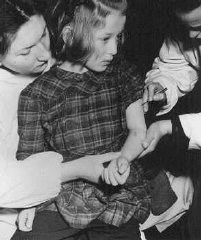
11-year-old girl who was a victim of medical experiments at Auschwitz
PhotoUnited Nations personnel vaccinate an 11-year-old concentration camp survivor who was a victim of medical experiments at the Auschwitz camp. Photograph taken in the Bergen-Belsen displaced persons camp, Germany, May 1946.
-
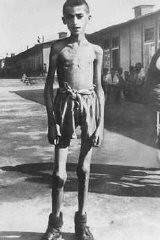
13-year-old survivor of the Mauthausen concentration camp
PhotoA 13-year-old orphan, a survivor of the Mauthausen concentration camp. Photograph taking following liberation of the camp. Austria, May 1945.
-
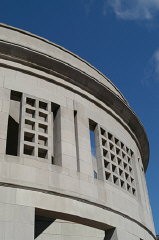
14th Street exterior
PhotoDetail of the 14th Street facade of the United States Holocaust Memorial Museum. Washington, DC, April 2003.
-
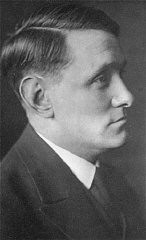
1915 portrait of Willem Arondeus
PhotoA 1915 portrait of Willem Arondeus. During World War II, Arondeus, a gay member of the Dutch resistance, participated in an attack on the Amsterdam Population Registry offices. His group set fire to several thousand files in an attempt to destroy government records of Jews and others sought by the Nazis. Soon after the attack, his unit was betrayed. The Nazis arrested and executed Arondeus in 1943. Blaricum, the Netherlands, 1915.
-
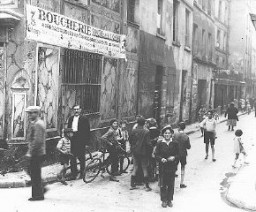
1930s street scene in the Jewish quarter of Paris
PhotoStreet scene in the Jewish quarter of Paris before World War II and the Holocaust. Paris, France, 1933–39.
-
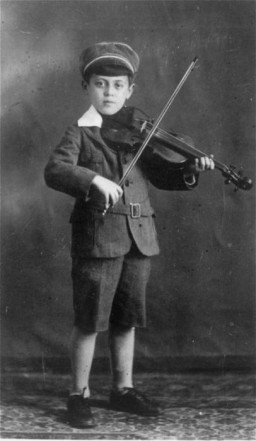
1931 studio portrait of Abraham Moshe Muhlbaum
PhotoAbraham and his family fled from Berlin to Amsterdam in October 1938. They found refuge in the Netherlands until January 28, 1943, when all the members of the Muhlbaum family, except Abraham, were deported to Westerbork. Abraham escaped over the rooftops during the round-up. He gradually established a new life as a member of a Dutch resistance group that included Joop Westerweel. In 1944, Abraham was arrested as a member of the resistance (his Jewish identity remained hidden). He was held…
-
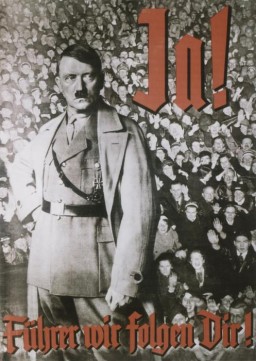
1934 Nazi Party propaganda poster
PhotoNazi propaganda constantly reinforced the notion that Hitler was the embodiment of the national will. Here, a determined looking Hitler in military dress stands with clenched fist, poised for action above the adoring crowd. The text on the poster says "Yes! Leader, We Follow You!" (Ja! Führer wir folgen Dir!) This poster, designed for a 1934 public referendum on uniting the posts of German chancellor and president, conveys unanimous popular support for Hitler.
-
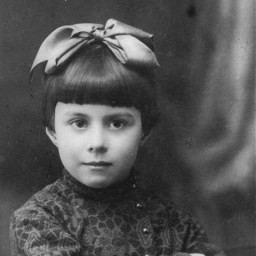
1935 portrait of three-year-old Anna Glinberg
PhotoClose-up studio portrait of a young Jewish girl named Anna Glinberg, who was later killed during the mass execution at Babi Yar.
-
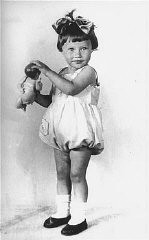
1936 portrait of two-year-old Mania Halef
Photo1936 portrait of two-year-old Mania Halef, a Jewish child, who was later killed during the mass execution at Babi Yar.
-
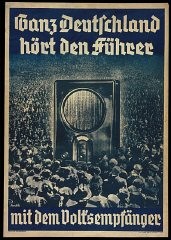
1936 poster: "All of Germany Listens to the Führer with the People's Radio"
Photo1936 poster: "All of Germany Listens to the Führer with the People's Radio." The poster depicts a crowd surrounding a radio. The radio looms large, symbolizing the mass appeal and broad audience for Nazi broadcasts. Bundesarchiv Koblenz (Plak003-022-025)
-
1937 studio portrait of Suri and Ari Deutsch
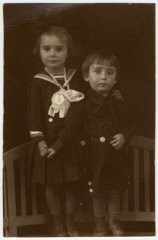
PhotoPrewar studio portrait in Sighet of Jewish siblings Suri and Ari Deutsch, both of whom died in the Holocaust. This photograph comes from the album of their cousin, Rosalia Dratler Roiter. Rosalia was deported to and died at Auschwitz. Sighet, Romania, 1937.
-
1943 portrait of Edgar Krasa drawn by Leo Haas in Theresienstadt
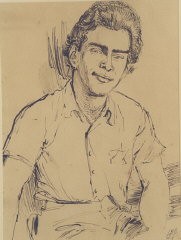
Photo1943 portrait of Edgar Krasa drawn by Leo Haas in Theresienstadt. Haas (1901-1983) was a Czech Jewish artist who, while imprisoned in Nisko and Theresienstadt during World War II, painted portraits and produced a large volume of drawings documenting the daily life of the prisoners.
-
1943 still life of a violin and sheet of music behind prison bars by Bedrich Fritta
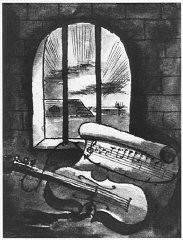
Photo1943 still life of a violin and sheet of music behind prison bars by Bedrich Fritta (1909–1945). Fritta was a Czech Jewish artist who created drawings and paintings depicting conditions in the Theresienstadt camp-ghetto. He was deported to Auschwitz in October 1944; he died there a week after his arrival.
-
1943 watercolor landscape of Theresienstadt painted by Otto Samisch
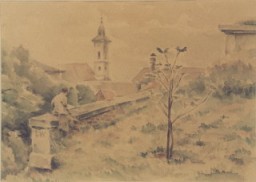
Photo1943 watercolor landscape of Theresienstadt painted by Otto Samisch. Despite the terrible living conditions and the constant threat of deportation, Theresienstadt had a highly developed cultural life.
-
1945 Nazi propaganda poster
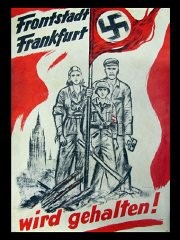
PhotoThis poster from 1945 shows an embattled German family proclaiming, "Frontline City Frankfurt will be held!" A Frontstadt was a city Hitler declared must be defended against Allied attack at all costs. In the final months of the war, propaganda efforts were directed at rallying the populace for a final defense of the country.
-
1945 photograph of Miles Lerman
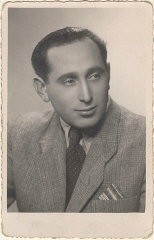
PhotoMiles Lerman (who married Regina's sister Krysia), Lodz, Poland, 1945.
-
1945 photograph of Regina (Laks) Gelb
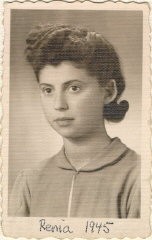
PhotoPhotograph of Regina (Renia) taken on June 2, 1945, in Lodz, Poland.
-
1945 portrait of Eta Wrobel
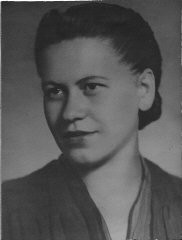
Photo1945 portrait of Eta Wrobel who was born on December 28, 1918, in Lokov, Poland. During the Holocaust, Eta helped organize an exclusively Jewish partisan unit of close to eighty people. She was the only child in her family of ten to survive.
-
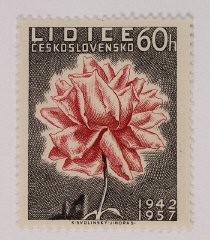
1957 Czech postage stamp commemorating Lidice
PhotoA Czech postage stamp issued in 1957, commemorating the fifteenth anniversary of the destruction of Lidice.
-
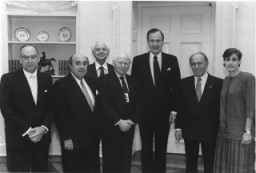
1989 Days of Remembrance
PhotoMembers of the United States Holocaust Memorial Council pose with President George Bush (third from right) on the occasion of the 1989 Days of Remembrance. Benjamin Meed is fourth from the right. Washington, DC, 1989. Learn more about Days of Remembrance.
-
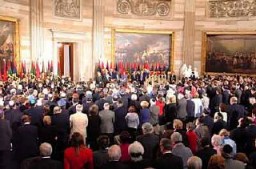
2001 Days of Remembrance ceremony
PhotoScene during the 2001 Days of Remembrance ceremony, in the Rotunda of the US Capitol. Flags of the liberating divisions feature prominently in the Museum's Days of Remembrance ceremonies. Washington, DC, 2001.
-
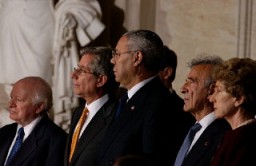
2003 Days of Remembrance ceremony
PhotoBenjamin Meed (left) with Fred S. Zeidman, Colin L. Powell, Elie Wiesel, and Ruth B. Mandel at the 2003 Days of Remembrance ceremony in the US Capitol Rotunda.
-
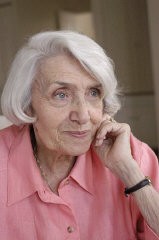
2004 portrait of Blanka Rothschild
PhotoBlanka was an only child in a close-knit family in Lodz, Poland. Her father died in 1937. After the German invasion of Poland, Blanka and her mother remained in Lodz with Blanka's grandmother, who was unable to travel. Along with other relatives, they were forced into the Lodz ghetto in 1940. She and her mother were deported to the Ravensbrueck camp in Germany in 1944. From Ravensbrueck, Blanka and her mother were sent to a subcamp of Sachsenhausen. Blanka was forced to work in an airplane factory…
-
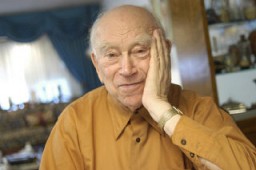
2004 portrait of Norman Salsitz
PhotoBorn Naftali Saleschutz, Norman was the youngest of nine children in a devout Hasidic Jewish family. They lived in Kolbuszowa, Poland. In the Hasidic tradition, he wore a long black coat and shoulder-length earlocks. He first faced antisemitism in the second grade when his teacher cut one earlock off each Jewish boy.
-
2004 portrait of Regina (Laks) Gelb
PhotoBorn as Regina Laks in 1929, she was raised in Starachowice, an industrial city in central Poland. Her mother, Pola Tennenblum, was an active member of the Zionist movement. Her father, Isaac Laks, was an engineer in the lumber industry. She had two older sisters.