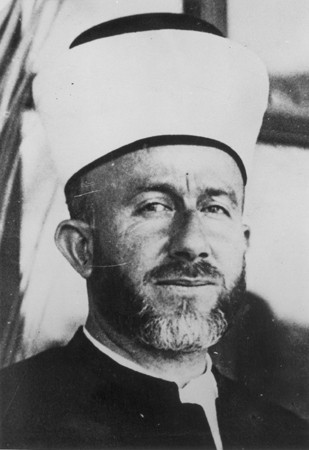
Hajj Amin al-Husayni: The Mufti of Jerusalem
Muhammad Amin al-Husayni (189?-1974) was the Mufti (chief Muslim Islamic legal religious authority) of Jerusalem under the political authority of the British Mandate in Palestine from 1921 to 1937. His primary political causes were:
- establishment of a pan-Arab federation or state
- opposition to further immigration of Jews to Palestine and Jewish national aspirations in Palestine
- promotion of himself as a pan-Arab and Muslim religious leader
In exile between 1937 and 1945, al-Husayni, claiming to speak for the Arab nation and the Muslim world, sought an alliance with the Axis powers (Nazi Germany and Fascist Italy) based on their publicly recognizing
- the independence of the Arab states
- the right of those states to form a union reflecting a dominant Muslim and specifically Arab culture
- the right of those states to reverse steps taken towards the creation of a Jewish homeland in Palestine
- al-Husayni himself as the spiritual and political representative of this pan-Arab, Muslim entity
In exchange, al-Husayni collaborated with the German and Italian governments by broadcasting pro-Axis, anti-British, and anti-Jewish propaganda via radio to the Arab world; inciting violence against Jews and the British authorities in the Middle East; and recruiting young men of Islamic faith for service in German military, Waffen-SS , and auxiliary units. In turn, the Germans and the Italians used al-Husayni as a tool to inspire support and collaboration among Muslim residents of regions under Axis control and to incite anti-Allied violence and rebellion among Muslims residing beyond the reach of German arms.
Despite his collaboration, the Axis powers were unwilling to promote al-Husayni's political ambitions as he wished. As the Nazi regime collapsed in 1945, French authorities took al-Husayni into custody. He escaped to Egypt in 1946. Al-Husayni devoted the remainder of his life to supporting Palestinian nationalism and to agitating against the State of Israel. He continued to produce and disseminate anti-Zionist, anti-Jewish, and anti-Israel propaganda. He died in Beirut, Lebanon, on July 4, 1974.