Immediate American Responses to the Nazi Book Burnings
The 1933 Nazi book burnings sparked response from anti-Fascist organizations, Jewish groups, and writers in the United States. American literary organizations provided aid to the rising number of German emigre writers in response to the crisis.
-
1
American newspapers nearly unanimously condemned the book burnings. While some responded with ridicule, others forecast the impending “dark age.”
-
2
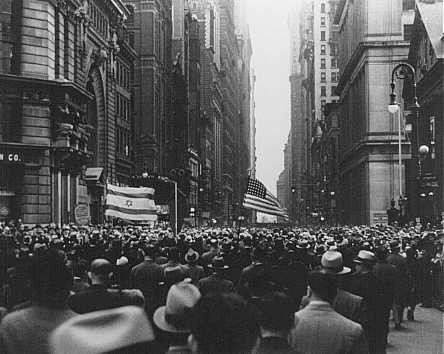
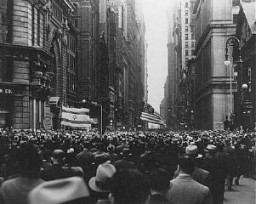
On May 10, 1933, the same day as the book burnings in Germany, nearly 100,000 people marched in New York City for more than six hours to protest events in Germany and the burning of books
-
3
American author Helen Keller—known for her socialist views and one of whose books was burned—wrote an open letter to German students, affirming the enduring power of ideas against tyranny.
Anti-fascist organizations, American Jewish groups, and numerous writers, scholars, and journalists recognized the ominous intent of the Nazi "culture war" that made blood and race the source of inspiration.
The American Jewish Congress hoped to broaden the coalition of anti-Nazi Americans by using the May 10 book burnings as a unifying cause. It urged mass street demonstrations to take place that same day. As the German literary blacklists circulated in the press, American authors published declarations of solidarity with their condemned brethren. Throughout the 1930s, as the flood of German émigré writers rose, American literary organizations provided aid where they could in response to the crisis.
Demonstrations
On May 10, 1933, the same day as the book burnings in Germany, massive street demonstrations took place in dozens of American cities. Skillfully organized by the American Jewish Congress, the demonstrators protested the relentless Nazi attacks upon Jews: the continued harassment, police raids, arrests, and beatings, as well as the destruction of Jewish property and the boycott of Jewish businesses. In the largest demonstration in New York City history up to that date, 100,000 people marched for more than six hours to protest events in Germany and the burning of books. Other mass demonstrations by a variety of American groups took place in cities across the country, including Philadelphia, Cleveland, and Chicago.
American Press Response
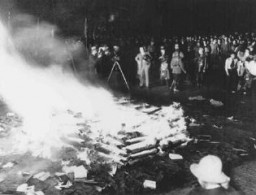
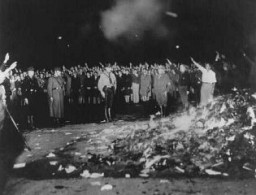
American newspapers nationwide reported both the Nazi bonfires and the American protests. Editorial opinion was nearly unanimous in its condemnation but uneven in its rhetoric. Some newspapers called the German student actions "silly," "ineffective," "senseless," or "infantile." The New Yorker made light of the "extra-curricular activities" of Nazi students.” Essayist E. B. White joked, "We never burn books except to keep them out of the hands of the grand jury." But others, such as Ludwig Lewisohn of The Nation, forecast the dawning of a "dark age," an "insane" assault "against the life of the mind, intellectual values, and the rights of the human spirit." In its coverage of the Berlin book burnings, News-Week employed the term "Holocaust" as a header introduction to its weekly report of news in Germany. The May 27 issue of News-Week featured an image of the Berlin book burning on the front cover. The Nation presented the book burnings as a pagan ritual for Nazi henchmen, Prussian militarists, monocled industrialists, SA thugs, and corrupted Hitler Youth. New York City's Forward, a Yiddish-language daily that advocated social justice and Jewish rights, vigorously protested Nazi policies. On May 10, the newspaper's editorial cartoon (titled The Führer) showed Hitler wielding a torch for a cartload of books. Its May 14, 1933, issue featured a full page of photographs identifying notable authors whose books were destroyed.
Authors Respond
Responding to the act of "national drunkenness" enveloped in "a stupid ceremony," as Thomas Mann later described the Nazi book burnings, a number of American writers publicly condemned the German student "action." Helen Keller wrote an open letter to German students, affirming the enduring power of ideas against tyranny.
When German authors became writers-in-exile, their American counterparts, notably members of the leftist League of American Writers, made efforts to help the émigrés and their dependents escape Europe by providing money, visas, shelter, food packages, grants, affidavits of support, as well as book and screenwriting contracts.
P.E.N.
International P.E.N. (poets, playwrights, essayists, editors, and novelists) was founded in 1912 to foster worldwide literary friendships, build bridges over cultural frontiers, and to work on behalf of free expression wherever it was endangered.
In April 1933, the Nazis purged the German P.E.N. Center of Communists, Jews, and writers holding liberal views. The P.E.N. International Congress in Dubrovnik, Yugoslavia, on May 26, 1933—two weeks after the book burnings—immediately witnessed a confrontation that occurred when some delegates accused the Germans of violating the organization's principles. After a motion passed to allow a speech by Ernst Toller, a German Jewish dramatist-in-exile, whose works had been burned, the German delegation walked out in protest.
Exiles and Aid to Refugees
The expulsion of Jews and political opponents from universities, the book burnings, and the continuing acts of persecution prompted writers, artists, doctors, and other professionals to flee Germany. Though America seemed a haven for intellectual émigrés, most refugees encountered an exclusionary immigration policy. US consular officials reflected American anti-alien, anti-refugee, and to a certain degree antisemitic attitudes. They narrowly interpreted the immigration laws that imposed quotas and required assurance the emigrant would not become a public charge. The obstacles were formidable, but between 1933 and 1941, with assistance from private groups, as many as 200,000 immigrants from Nazi Germany reached American shores.
In contrast to the relative inaction of the US government, dozens of private, ad hoc volunteer organizations responded to the 1933 crisis and the displacement of German students, academics, and artists. Alvin Johnson, director of the New School for Social Research, quickly secured funds from benefactor Hiram Halle and by year's end, assembled a faculty of fifteen émigré social scientists as the nucleus of a “University in Exile.” The Emergency Committee in Aid of Displaced German Scholars, founded by Stephen Duggan, director of the Institute of International Education, worked with museum directors, librarians, and university presidents to rescue and find employment for eminent academics representing the humanities, natural sciences, social sciences, and medicine.
Beginning in May 1933, the Emergency Committee in Aid of Displaced German Scholars made grants to dozens of academic institutions to create honorary professorships with the aid of Jewish philanthropy, the Rockefeller Foundation, the Carnegie Corporation, and the Oberlaender Trust. Over its 12-year history, the committee supported 355 displaced scholars and professionals out of more than 6,000 applicants. Before joining the European staff of the Columbia Broadcasting System, 25-year-old Edward R. Murrow served as secretary to the Emergency Committee in Aid of Displaced German Scholars.
In the aftermath of the book burnings, most of the blacklisted authors managed to flee Germany. A number of authors, however, including Erich Mühsam and Carl von Ossietzky, were not as fortunate. They remained trapped in Germany and died after imprisonment and torture in concentration camps. Many who escaped found it difficult to start life anew. Some despaired and chose suicide, including Kurt Tucholsky, Ernst Toller, and Stefan Zweig. During the 1930s, émigré writers were chiefly responsible for keeping the memory of the book burnings before the American public, profiling themselves publicly as victims of the Nazi autos-da-fé through exhibits, lectures, commemorations, and, in 1938, a demonstration at the German consulate in New York City.

Critical Thinking Questions
- If Jews were the principal target during the Holocaust, why were books written by non-Jewish authors burned?
- How did the German public react to the book burnings? What were some of the reactions outside of Germany?
- Why do oppressive regimes promote or support censorship and book burning? How might this be a warning sign of mass atrocity?