Science as Salvation: Weimar Eugenics, 1919–1933
Eugenics was a scientific movement of the late 19th and early 20th centuries. Supporters of eugenics claimed that it offered biological solutions to social problems.
-
1
The term “eugenics” was coined in 1883. It comes from the Greek for “of good birth or stock.”
-
2
In the 1910s and 1920s, eugenics ideas were embraced worldwide, especially in western Europe and the United States.
-
3
Today, eugenics has been discredited as a racially biased pseudoscience.
Eugenics in Germany
Following Germany’s defeat in World War I and during the political and economic crises of the Weimar Republic, ideas known as racial hygiene or eugenics began to inform population policy, public health education, and government-funded research. Proponents of eugenics argued that by keeping the “unfit” alive to reproduce and multiply, modern medicine and costly welfare programs interfered with natural selection. (Natural selection was the concept that Charles Darwin applied to the “survival of the fittest” in the animal and plant world.) In contrast, members of the “fit,” educated classes were marrying later and using birth control methods to limit family size. The result, eugenics advocates believed, was an overall biological “degeneration” of the population. As a solution, they proposed “positive” government policies such as tax credits to foster large, “valuable” families, and “negative” measures, mainly the sterilization of genetic “inferiors.”
Eugenics advocates in Germany included physicians, public health officials, and academics in the biomedical fields, on the political left and right. Serving on government committees and conducting research on heredity, experts warned that if the nation did not produce more fit children, it was headed for extinction. A growing faction, linking eugenics to race, championed the long-skulled, fair “Nordics” as “eugenically advantageous” and discussed “race mixing” as a source of biological degeneration. Eugenics ideas were absorbed into the ideology and platform of the developing Nazi Party during the 1920s.
"If one thinks of a battlefield [in World War I] covered with thousands of dead youth and contrasts this with our institutions for the feebleminded with their solicitude for their living patients—then one would be deeply shocked by the glaring disjunction between the sacrifice of the most valuable possession of humanity on one side and on the other the greatest care of beings who are not only worthless but even manifest negative value."
Karl Binding and Alfred Hoche, Authorization of the Destruction of Life Unworthy of Life, Leipzig, 1920
International Eugenics
German proponents of eugenics were part of an international phenomenon.
The English scientist Francis Galton had coined the term eugenics, meaning “of good birth,” in 1883. German biologist August Weissmann’s theory of “immutable germ plasm,” published in 1892, fostered growing international support for eugenics, as did the rediscovery in 1900 of Austrian botanist Gregor Mendel’s theory that the biological makeup of organisms was determined by certain “factors” that were later identified with genes. (The term gene was first used by a Danish scientist in 1909.)
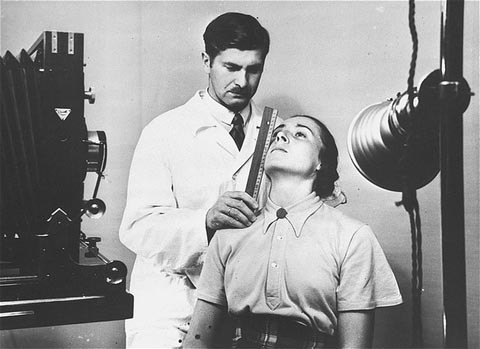
Reform-minded proponents of eugenics worldwide offered biological solutions to social problems common to societies experiencing urbanization and industrialization. After classifying individuals into labeled groups using the scientific methods of the day—observation, family genealogies, physical measurements, and intelligence tests—they ranked the groupings from “superior” to “inferior.”
When perfected, surgical sterilization became the most common proposal for preventing unproductive “inferiors” from reproducing and for saving on costs of special care and education. But sterilization gained only limited political support. Catholics objected to interfering with human reproduction, and liberals decried the violation of individual rights. Before 1933, the passage of national statutes legalizing “voluntary” sterilization of inmates of prisons and state mental hospitals proved politically feasible only in Denmark, where the law was little used.
Eugenicists were more successful promoting sterilization laws in individual provinces, cantons, or states in Canada, Switzerland, and the United States.