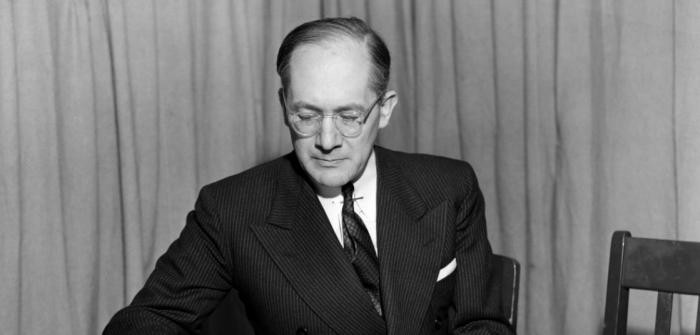
Coining a Word and Championing a Cause: The Story of Raphael Lemkin
Raphael Lemkin, a Polish-Jewish jurist, was born in 1900 on a small farm near the Polish town of Wolkowysk.
From childhood, Lemkin was fascinated with the history of religious and ethnic persecution. He was also keenly aware of antisemitic pogroms. Then, as a law student in his twenties, Lemkin learned about the Ottoman destruction of the Armenians during World War I (known today as the Armenian Genocide). His outrage about historical and contemporary events of group-targeted mass violence inspired his belief that there should be an international law against the destruction of groups.
During the 1930s, Lemkin sought to introduce legal safeguards for ethnic, religious, and social groups at international forums, but without success. When the German army invaded Poland, he escaped from Europe, eventually reaching safety in the United States, where he took up a teaching position at Duke University. He moved to Washington, DC, in the summer of 1942, to join the War Department as an analyst and went on to document Nazi atrocities in his 1944 book, Axis Rule in Occupied Europe. In this text, he introduced the word “genocide.”
“By ‘genocide’ we mean the destruction of a nation or of an ethnic group. This new word, coined by the author to denote an old practice in its modern development, is made from the ancient Greek word genos (race, tribe) and the Latin cide (killing)…. Generally speaking, genocide does not necessarily mean the immediate destruction of a nation, except when accomplished by mass killings of all members of a nation. It is intended rather to signify a coordinated plan of different actions aiming at the destruction of essential foundations of the life of national groups, with the aim of annihilating the groups themselves. Genocide is directed against the national group as an entity, and the actions involved are directed against individuals, not in their individual capacity, but as members of the national group” 1
He later served with the team of Americans working to prepare the Nuremberg trials, where he was able to get the word “genocide” included in the indictment against Nazi leadership. But “genocide” was not yet a legal crime, and the verdict at Nuremberg did not cover peacetime attacks against groups, only crimes committed in conjunction with an aggressive war. While in Nuremberg, Lemkin also learned of the death of 49 members of his family, including his parents, in killing centers and concentration camps, the Warsaw ghetto, and death marches.
He returned from Europe determined to see “genocide” added to international law and began lobbying for this at early sessions of the United Nations. His tireless efforts to enlist the support of national delegations and influential leaders eventually paid off. On December 9, 1948, the United Nations approved the Convention on the Prevention and Punishment of Genocide.
Lemkin did not rest with the UN document, but committed the rest of his life to urging nations to pass legislation supporting the Convention. He died in 1959, impoverished and exhausted by his efforts.
Critical Thinking Questions
- Why was it important to give a name to the actions now labeled as “genocide”?
- Why might the international community hesitate to name an event a genocide?
- Investigate how and when the term “genocide”has been applied (or avoided) since then.
- Has your country signed the UN Convention on the Prevention and Punishment of Genocide? When did it sign and why?