Book Burning
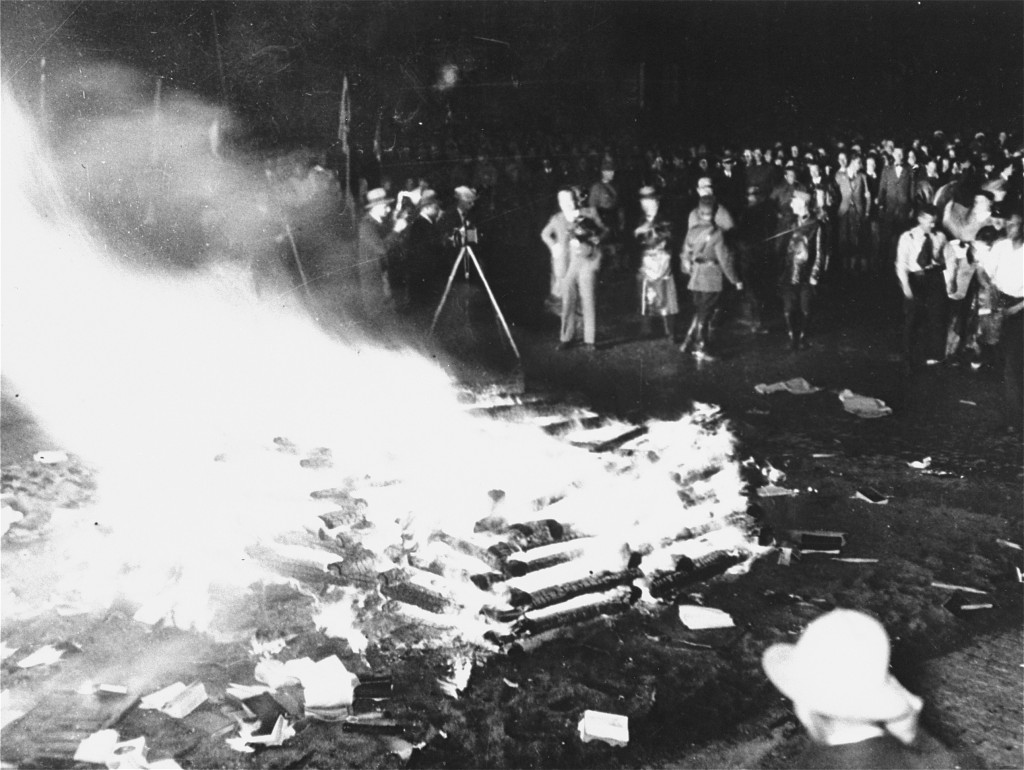
Beginning on May 10, 1933, Nazi-dominated student groups carried out public burnings of books they claimed were “un-German.” The book burnings took place in 34 university towns and cities. Works of prominent Jewish, liberal, and leftist writers ended up in the bonfires. The book burnings stood as a powerful symbol of Nazi intolerance and censorship.
-
1
The Nazi university student association created blacklists of works by literary and political figures such as Bertolt Brecht, Erich Maria Remarque, and Ernest Hemingway that were to be thrown into the flames.
-
2
In the aftermath of the book burnings, the Nazi regime raided book stores, libraries, and publishers’ warehouses to confiscate materials it deemed dangerous or “un-German.”
-
3
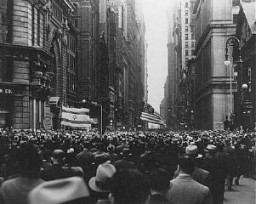
The Nazi book burnings provoked international criticism from intellectuals and the press. They saw it as a barbaric act that was out of keeping with a modern, civilized society.
Introduction
Book burning has a long and dark history.
Book burning refers to the ritual destruction by fire of books or other written materials. Usually carried out in a public context, the burning of books represents an element of censorship and usually proceeds from a cultural, religious, or political opposition to the materials in question.
The burning of books under the Nazi regime on May 10, 1933, is perhaps the most famous book burning in history.
A Nineteenth-Century Precedent
The May 1933 book burning in Nazi Germany had a precedent in nineteenth century Germany. In 1817, German student associations (Burschenschaften) chose the 300th anniversary of Luther’s 95 Theses to hold a festival at the Wartburg, a castle in Thuringia where Luther had sought sanctuary after his excommunication. The students, demonstrating for a unified country—Germany was then a patchwork of states—burned anti-national and reactionary texts and literature which the students viewed as “Un-German.”
"Synchronizing" Culture with Nazi Ideology
In 1933, Nazi German authorities aimed to synchronize professional and cultural organizations with Nazi ideology and policy (Gleichschaltung). Joseph Goebbels, Nazi Minister for Popular Enlightenment and Propaganda, began an effort to bring German arts and culture in line with Nazi goals. The government purged cultural organizations of Jewish and other officials alleged to be politically suspect or who performed or created art works which Nazi ideologues labeled “degenerate.”
In an effort to synchronize the literary community, Goebbels had a strong ally in the National Socialist German Students’ Association (Nationalsozialistischer Deutscher Studentenbund, or NSDStB). German university students were among the vanguard of the early Nazi movement, and in the late 1920s, many filled the ranks of various Nazi formations. The ultra-nationalism and antisemitism of middle-class, secular student organizations had been intense and vocal for decades. After World War I, many students opposed the Weimar Republic (1919–1933) and found in National Socialism a suitable vehicle for their political discontent and hostility.
On April 6, 1933, the Nazi German Student Association's Main Office for Press and Propaganda proclaimed a nationwide “Action against the Un-German Spirit,” to climax in a literary purge or “cleansing” (Säuberung) by fire. Local chapters were to supply the press with releases and commissioned articles, offer blacklists of “un-German” authors, sponsor well-known Nazi figures to speak at public gatherings, and negotiate for radio broadcast time.
On April 8 the students’ association also drafted its twelve "theses"—a deliberate evocation of Martin Luther’s 95 Theses: declarations which described the fundamentals of a "pure" national language and culture. Placards publicized the theses, which attacked “Jewish intellectualism,” asserted the need to “purify” the German language and literature, and demanded that universities be centers of German nationalism. The students described the “action” as a response to a worldwide Jewish “smear campaign” against Germany and an affirmation of traditional German values.
[caption=3a6b4ac4-8377-4a28-af45-b5d1646c9d9a] - [credit=3a6b4ac4-8377-4a28-af45-b5d1646c9d9a]
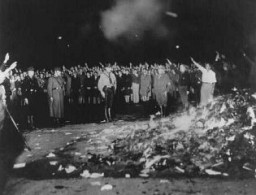
In a symbolic act of ominous significance, on May 10, 1933, university students burned upwards of 25,000 volumes of “un-German” books, presaging an era of state censorship and control of culture. On the evening of May 10, in most university towns, right-wing students marched in torchlight parades “against the un-German spirit.” The scripted rituals called for high Nazi officials, professors, university rectors, and university student leaders to address the participants and spectators.
At the meeting places, students threw the pillaged and “unwanted” books onto bonfires with great ceremony, band-playing, and so-called “fire oaths.” In Berlin, some 40,000 persons gathered in the Opernplatz to hear Joseph Goebbels deliver a fiery address: “No to decadence and moral corruption!” Goebbels enjoined the crowd. “Yes to decency and morality in family and state! I consign to the flames the writings of Heinrich Mann, Ernst Gläser, Erich Kästner.”
Which Authors and Works were Targeted?
Among the authors whose books student leaders burned that night were well-known socialists such as Bertolt Brecht and August Bebel; the founder of the concept of communism, Karl Marx; critical “bourgeois” writers like the Austrian playwright Arthur Schnitzler; and “corrupting foreign influences,” among them American author Ernest Hemingway.
The fires also consumed several writings of the 1929 Nobel Prize-winning German author Thomas Mann, whose support of the Weimar Republic and critique of fascism raised Nazi ire. Also burned were works of international best-selling author Erich Maria Remarque. Nazi ideologues vilified Remarque's unflinching description of war, All Quiet on the Western Front, as "a literary betrayal of the soldiers of the World War." Works by early German literary critics of the Nazi regime were also burned, such as those of Erich Kästner, Heinrich Mann, and Ernst Gläser.
Other writers included on the blacklists were American authors Jack London, Theodore Dreiser, and Helen Keller, whose belief in social justice encouraged her to champion the disabled, pacifism, improved conditions for industrial workers, and women's voting rights.
Jewish authors numbered among the writers whose works were burned, among them some of the most famous contemporary writers of the day, such as Franz Werfel, Max Brod, and Stefan Zweig.
Also among those works burned were the writings of beloved nineteenth-century German Jewish poet Heinrich Heine, who wrote in his 1820–1821 play Almansor the famous admonition, “Dort, wo man Bücher verbrennt, verbrennt man am Ende auch Menschen": "Where they burn books, they will also ultimately burn people."
Not all book burnings took place on May 10, as the German Student Association had planned. Some were postponed a few days because of rain. Others, based on local chapter preference, took place on June 21, the summer solstice, a traditional date for bonfire celebrations in Germany.
Nonetheless, in 34 university towns across Germany the May 10th "Action against the Un-German Spirit" was a success, receiving widespread newspaper coverage. In some cities, notably Berlin, radio broadcasts brought the speeches, songs, and ceremonial chants "live" to countless German listeners. The promotion of "Aryan" culture and the suppression of other forms of artistic production was yet another Nazi effort to "purify" Germany.
Why do Totalitarian Regimes Often Target Culture?
In this short film, a Holocaust survivor, an Iranian author, an American literary critic, and two Museum historians discuss the Nazi book burnings and why totalitarian regimes often target culture, particularly literature.

Critical Thinking Questions
- If Jews were the principal target during the Holocaust, why were books written by non-Jewish authors burned?
- How did the German public react? What was reaction like outside of Germany?
- Why do oppressive regimes promote or support censorship and book burning? Why might this be a warning sign for mass atrocity?
- How can knowledge of the events in Germany and Europe before the Nazis came to power help citizens today respond to threats of genocide and mass atrocity in the world?