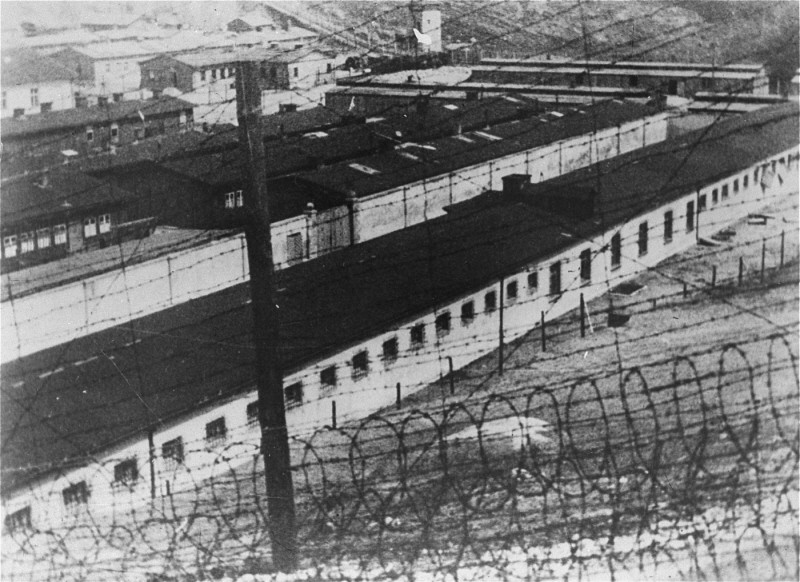
Flossenbürg
Between 1933 and 1945, Nazi Germany and its allies established more than 44,000 camps and other incarceration sites (including ghettos). The perpetrators used these locations for a range of purposes, including forced labor, detention of people deemed to be "enemies of the state," and mass murder. Millions of people suffered and died or were killed. Among these sites was the Flossenbürg camp and its subcamps.
On March 24, 1938, SS authorities determined a site near the small town of Flossenbürg to be suitable for the establishment of a concentration camp, due to its potential for extracting granite for construction purposes. The site lay in northeastern Bavaria near the Czech border, less than ten miles northeast of Weiden.
Prisoners in the Camp
Six weeks later, on May 3, 1938, the first 100 prisoners transported from Dachau concentration camp arrived at the newly designated Flossenbürg concentration camp. Initially, the SS intended the camp as a place of detention for males, particularly those rounded up in the winter and spring of 1938 in the course of the major police operations to remove so-called asocial persons and repeat criminal offenders from German streets. The SS planned to deploy the prisoners as forced laborers in the nearby stone quarry owned by the SS company German Earth and Stone Works (Deutsche Erd- und Steinwerke).
By the end of 1938, nearly 1,500 prisoners were in the camp, most of them repeat criminal offenders and “asocials,” with a few homosexuals. Approximately 1,000 political prisoners, mostly of German nationality arrived in Flossenbürg in late 1939. They had been in Dachau concentration camp, which SS authorities temporarily closed down in order to use the site for training the first authorized SS military units (later to be designated the Waffen SS).
Although the Dachau prisoners returned to Dachau in late spring 1940, new political prisoners replaced them in Flossenbürg, including the first Czech prisoners. In 1941, an influx of approximately 1,500 Polish prisoners followed, many of them were members of the Polish resistance. By the end of 1941, approximately 3,150 prisoners were incarcerated in Flossenbürg along with 1,750 Soviet prisoners of war, who were held in a separate compound within the camp grounds.
There were over 4,000 prisoners in the Flossenbürg main camp in February 1943. More than half were political prisoners (mainly Soviet, Polish, Czech, Dutch, and German). Almost 800 were Germans identified as repeat criminal offenders; more than 100 were homosexuals; and seven were Jehovah's Witnesses. Over the next eighteen months, hundreds of prisoners, mostly French, arrived in Flossenbürg after having been seized by German occupation authorities under the Night and Fog (Nacht und Nebel) Decree.
Before 1944, relatively few Jews were prisoners in Flossenbürg, probably no more than 100. In mid-October 1942, the SS deported the surviving 12 Jews to Auschwitz in accordance with general SS orders concerning Jews in German concentration camps. To this point, according to the official camp death registry, 78 Jews had died in the camp.
Between August 4, 1944 and the middle of January 1945, at least 10,000 Jews, mostly Hungarian and Polish Jews, arrived in Flossenbürg and its subcamps. Some 13,000 more came in the winter months of 1945, as the SS evacuated other camps to the East and West. In January 1945, there were almost 40,000 prisoners in the Flossenbürg camp system, including almost 11,000 women. At its high point in March 1945, nearly 53,000 prisoners were in Flossenbürg camp system, with about 14,500 in the main camp.
Forced Labor and Conditions in the Camp

Initially, the SS staff deployed the prisoners in the construction of the concentration camp itself and in the nearby granite quarry. Until mid-1943, the quarry occupied the labor of about half of the prisoner population. Another employer was an SS-owned weaving workshop. In accordance with SS efforts to provide forced labor for the German armaments industry, the Messerschmidt company established a plant in February 1943, in which prisoners produced parts for ME-109 fighter planes. After Allied bombers seriously damaged the central Messerschmidt plant in Regensburg in August 1943, the company's managers moved surviving production facilities to various locations, among them concentration camps, including Flossenbürg and its subcamps. The production of aircraft parts thus dominated labor deployment in the Flossenbürg system by 1944.
The conditions under which the camp authorities forced the prisoners to work and the absence of even rudimentary medical care facilitated the spread of disease, including dysentery and typhus. In addition to the dreadful living conditions, the prisoners suffered beatings and arbitrary punishments. SS overseers and prisoner functionaries (the camp and block elders, and the Kapos) abused and killed prisoners according to whim in addition to the typical “official” punishments of prisoners (solitary confinement, standing at attention for hours, whipping, hanging from posts, and transfer to penal labor details).
A condition unique to Flossenbürg was the presence and “veteran status” of the numerous criminal offenders in the prisoner population. Tolerated by the SS, they tended to dominate the prisoner administration, which, as a result, was particularly brutal and corrupt. This hierarchy of criminal prisoners distinguished itself in sexual exploitation of lower ranking prisoners: coerced homosexual relationships and outright rape occurred frequently enough to induce the camp authorities to segregate male minors in a separate barracks, in a futile attempt to prohibit efforts to sexually prey upon them.
The SS Hierarchy in the Camp
The SS hierarchy at Flossenbürg was no less corrupt and brutal. The first commandant, SS Major Jakob Weiseborn turned up dead in his apartment under mysterious circumstances on January 20, 1939, spawning rumors that he had committed suicide to avoid scandal. His replacement, SS Lieutenant Colonel Karl Künstler was often drunk during the two and one half years he served as commandant; in August 1942, he was sent to the Balkans as a supply officer for an anti-partisan unit. From September 1942 until April 1943, SS Major Egon Zill commanded Flossenbürg. SS Major Max Koegel replaced Zill and remained commandant until the end of the war.
Subcamps
As prisoner forced labor became increasingly important in German arms production, the SS authorities established around 100 subcamps of Flossenbürg, concentrated mainly around armaments industries in southern Germany and western Czechoslovakia. One labor detachment was assigned to work on the agricultural estate of the widowed spouse of SS General Reinhard Heydrich, the former chief of the RSHA, who had died in June 1942 as the result of an assassination attempt in Prague.
Mortality in Flossenbürg
In addition to the generally high mortality rate, which included 1,367 deaths recorded for March 1945 alone, the camp authorities conducted numerous individual and mass shootings characterized as “executions.” SS guards had shot more than 1,000 Soviet prisoners of war in Flossenbürg by the end of 1941; shootings of Soviet prisoners of war continued sporadically through 1944.
Between February and September 1941, camp authorities shot about 500 Polish prisoners, including a July 1941 shooting of 40 Polish prisoners at the SS firing range outside the camp. In 1944, the SS in Flossenbürg murdered 40 Soviet prisoners of war whom they had identified as leaders of a prisoner revolt in the subcamp of Mülsen Sankt Micheln.
On March 29, 1945, the SS hanged 13 Allied prisoners of war (including one US soldier), who had been captured behind German lines on the Normandy coast in the previous summer. Ten days later, on April 9, after a drumhead court martial inside the camp, the SS hanged several prominent prisoners linked, however tenuously, to the July 20, 1944 conspiracy, including former military intelligence (Abwehr) chief Admiral Wilhelm Canaris, his deputy, Major-General Hans Oster, and Pastor Dietrich Bonhoeffer, whom Oster had recruited into the Abwehr in 1939. The Gestapo had arrested Bonhoeffer and Oster in April 1943, and Canaris in the aftermath of the failed attempt to kill Hitler in July 1944.
Forced Evacuation from Flossenbürg
As US forces approached the camp, in mid-April 1945, the SS began the forced evacuation of prisoners, except those unable to walk, from the Flossenbürg camp. Between April 15 and April 20, the SS moved most of the remaining 9,300 prisoners in the main camp (among them approximately 1,700 Jews), reinforced by about 7,000 prisoners who had arrived in Flossenbürg from Buchenwald, in the direction of Dachau both on foot and by train. Perhaps 7,000 of these prisoners died en route, either from exhaustion or starvation, or because SS guards shot them when they could no longer keep up the pace.
Thousands of others escaped, were liberated by advancing US troops, or found themselves free when their SS guards deserted during the night. Fewer than 3,000 of those who left Flossenbürg main camp arrived in Dachau, where they joined some 3,800 prisoners from the Flossenbürg subcamps. When members of the 358th and 359th US Infantry Regiments (90th US Infantry Division) liberated Flossenbürg on April 23, 1945, just over 1,500 prisoners remained in the camp. As many as 200 of them died after liberation.
Nearly 97,000 prisoners (of whom just over 16,000 were female) passed through the Flossenbürg system between 1938 and 1945. An estimated 30,000 prisoners died in Flossenbürg and its subcamps or on the evacuation routes, including 3,515 Jews.
Critical Thinking Questions
- Flossenburg had over 100 sub-camps. What does this indicate about the systematic nature of the camp system as well as the range of staff and services needed for this complex?
- To what degree was the German population aware of this camp, its purpose, and the conditions within?
- Did the outside world have any knowledge about this camp? If so, what actions were taken by other countries and their officials? What choices do other countries have in the face of mistreatment of civilians?