Treaty of Versailles
After the devastation of World War I, the victorious powers imposed a series of treaties upon the defeated powers. Among the treaties, the 1919 Treaty of Versailles held Germany responsible for starting the war. Germany became liable for the cost of massive material damages. The shame of defeat and the 1919 peace settlement played an important role in the rise of Nazism in Germany and the coming of a second “world war” just 20 years later.
-
1
The treaty required demilitarization of the Rhineland, the loss of 13% of Germany’s prewar territories, and extensive reparation payments by Germany.
-
2
The treaty contained a "war guilt clause." This clause held Germany completely responsible for starting World War I.
-
3
The effects of World War I and its divisive peace echoed in the decades to come, giving rise to a second world war and genocide committed under its cover.
Background: The Impact of World War I
World War I was one of the most destructive wars in modern history. The opposing sides in World War I were the Entente Powers and the Central Powers.
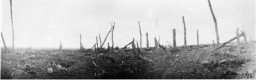
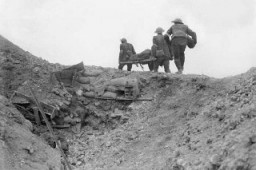
Nearly ten million soldiers died. The enormous losses on all sides resulted in part from the introduction of new weapons like the machine gun and gas warfare. Military leaders failed to adjust their tactics to the increasingly mechanized nature of warfare. A policy of attrition, particularly on the Western Front, cost the lives of hundreds of thousands of soldiers.
[caption=647ba4e2-8fc6-4340-9d0c-21dd535eaf42] - [credit=647ba4e2-8fc6-4340-9d0c-21dd535eaf42]
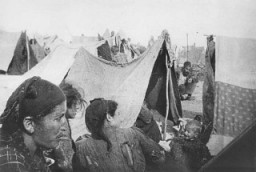
No official agencies kept careful track of civilian losses during the war years. Scholars suggest that as many as thirteen million non-combatants died as a direct or indirect result of the war. The conflict uprooted or displaced millions of persons from their homes in Europe and Asia Minor.
Property and industry losses were catastrophic, especially in France, Belgium, Poland, and Serbia, where fighting had been heaviest.
Background: The "Fourteen Points"
In January 1918, some ten months before the end of World War I, US President Woodrow Wilson had written a list of proposed war aims which he called the “Fourteen Points.”
Eight of these points dealt specifically with territorial and political settlements to accompany a victory of the Entente Powers (Great Britain, France, and Russia). One important point was the idea of national self-determination for ethnic populations in Europe. Other points focused on preventing war in the future. The last principle proposed a League of Nations to arbitrate international disputes. Wilson hoped his proposal would bring about a just and lasting peace: a “peace without victory.”
German leaders signed the armistice (an agreement to stop fighting) in the Compiègne Forest on November 11, 1918. Many of them believed then that the Fourteen Points would form the basis of the future peace treaty. But when the heads of the governments of the United States, Great Britain, France, and Italy met in Paris to discuss treaty terms, the European countries of the “Big Four” rejected this approach.
After the devastation of World War I, the victorious Western powers (Great Britain, the United States, France, and Italy, known as the “Big Four”) imposed a series of treaties upon the defeated Central Powers (Germany, Austria–Hungary, Bulgaria, and Turkey).
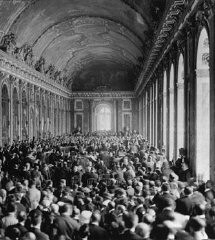
Viewing Germany as the chief instigator of the conflict, the European Allied powers decided instead to impose harsh treaty terms upon defeated Germany. The treaty was presented to the German delegation for signature on May 7, 1919, at the Palace of Versailles near Paris. The Treaty of Versailles held Germany responsible for starting the war and liable for massive material damages.
Provisions of the Versailles Treaty
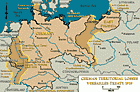
Germany lost 13 percent of its territory, including 10 percent of its population. The Treaty of Versailles forced Germany to:
- concede Eupen-Malmédy to Belgium
- concede the Hultschin district to Czechoslovakia
- concede Poznan, West Prussia, and Upper Silesia to Poland
- return Alsace and Lorraine, annexed in 1871 after the Franco-Prussian War, to France.
The treaty called for:
- demilitarization and occupation of the Rhineland
- special status for the Saarland under French control
- referendums to determine the future of areas in northern Schleswig on the Danish-German frontier and parts of Upper Silesia on the border with Poland.
Further, all German overseas colonies were taken away from Germany and became League of Nation Mandates. The city of Danzig (today Gdansk), with its large ethnically German population, became a Free City.
Perhaps the most humiliating portion of the treaty for defeated Germany was Article 231, commonly known as the "War Guilt Clause." This clause forced the German nation to accept complete responsibility for starting World War I. As such, Germany was to be held liable for all material damages.
France's premier, Georges Clemenceau, in particular, insisted on imposing enormous reparation payments. While aware that Germany would probably not be able to pay such a towering debt, Clemenceau and the French still greatly feared rapid German recovery and a new war against France.
The French sought to limit Germany's potential to regain its economic superiority and also to rearm. The German army was to be limited to 100,000 men. Conscription was forbidden. The treaty restricted the Navy to vessels under 10,000 tons, with a ban on the acquisition or maintenance of a submarine fleet. Germany was forbidden to maintain an air force.
Finally, Germany was required to conduct war crimes proceedings against the Kaiser and other leaders for waging aggressive war. The subsequent Leipzig Trials, without the Kaiser or other significant national leaders in the dock, resulted largely in acquittals. They were widely perceived as a sham, even in Germany.
Impact of the Treaty
The harsh terms of the peace treaty did not ultimately help to settle the international disputes which had initiated World War I. On the contrary, the treaty got in the way of inter-European cooperation and intensified the underlying issues which had caused the war in the first place.
For the populations of the defeated powers—Germany, Austria, Hungary, and Bulgaria—the peace treaties came across as unfair punishment. Their governments quickly resorted to violating the military and financial terms of the treaties. This was the case whether the governments were democratic as in Germany or Austria, or authoritarian in the case of Hungary and Bulgaria. Efforts to revise and defy provisions of the peace became a key element in their foreign policies and became a destabilizing factor in international politics.
A “dictated peace?”
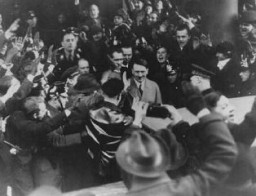
The newly formed German democratic government saw the Versailles Treaty as a “dictated peace” (Diktat). The war guilt clause, huge reparation payments, and limitations on the German military seemed particularly oppressive to most Germans. To many Germans, the treaty seemed to contradict the very first of Wilson’s Fourteen Points, which called for transparency in peace negotiations and diplomacy. Revision of the Versailles Treaty was one of the platforms that gave radical right-wing parties in Germany such credibility to mainstream voters in the 1920s and early 1930s. Among these parties was Adolf Hitler's Nazi Party.
Promises to rearm, reclaim German territory, remilitarize the Rhineland, and regain European and world prominence after the humiliating defeat and peace appealed to ultranationalist sentiment. These promises helped some average voters to overlook the more radical tenets of Nazi ideology.
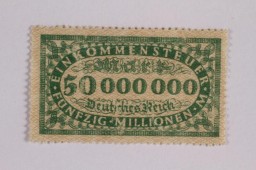
The reparations and a general inflationary period in Europe in the 1920s caused spiraling hyperinflation of the German Reichsmark by 1923. This hyperinflationary period combined with the effects of the Great Depression (beginning in 1929) to undermine the stability of the German economy. These conditions wiped out the personal savings of the middle class and led to massive unemployment. Such economic chaos contributed to social unrest and the instability of the fragile Weimar Republic.
Stab-in-the-Back Legend
Finally, the efforts of the Western European powers to marginalize Germany through the Versailles Treaty undermined and isolated German democratic leaders.
Some in the general population believed that Germany had been “stabbed in the back” by the “November criminals”—those who had helped to form the new Weimar government and negotiate the peace. Many Germans “forgot” that they had applauded the fall of Germany’s emperor, initially welcomed parliamentary democratic reform, and celebrated the armistice. They recalled only that the German Left—commonly seen as Socialists, Communists, and Jews—had surrendered German honor to a shameful peace.
This Dolchstosslegende (stab-in-the-back legend) helped to discredit the German socialist and liberal circles who were most committed to Germany's fragile democratic experiment. The difficulties caused by social and economic unrest in the aftermath of World War I and its peace undermined democratic solutions in Weimar Germany.
German voters ultimately found this kind of leadership in Adolf Hitler and his Nazi Party.
Series: The Weimar Republic

Series: World War I
Switch Series
Critical Thinking Questions
- <p>What national interests guided the terms of the Treaty?</p>
- <p>How and why might the German public have been surprised by the terms of the Treaty?</p>
- <p>How did conditions in Germany and Europe at the end of World War I contribute to the rise and triumph of Nazism in Germany?</p>
- <p>How can knowledge of the events in Germany and Europe before the Nazis came to power help citizens today respond to threats of genocide and mass atrocity in the world?</p>
- <p>Given that many historians agree that the Treaty was a major factor in setting the stage for World War II, what lessons can be taken from the choices made by the victorious Powers?</p>
Further Reading
Boemeke, Manfred F., Gerald D. Feldman, and Elisabeth Gläser, editors. The Treaty of Versailles: A Reassessment After 75 Years. Washington, DC: German Historical Institute, 1998.
Henig, Ruth B. Versailles and After, 1919–1933. London: Routledge, 1995.
MacMillan, Margaret. Paris 1919: Six Months That Changed the World. New York: Random House, 2002.