Quakers
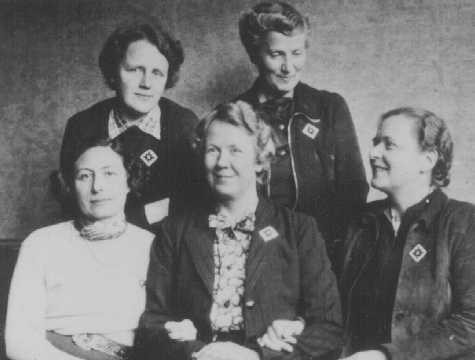
Though a small religious movement, the Society of Friends (Quakers) organized relief and advocated rescue in Europe before, during, and after the Holocaust. The American Friends Service Committee became an important part of a rescue network helping refugees. The group worked in French internment camps, hid Jewish children, and assisted thousands of Jewish and non-Jewish refugees with immigration and resettlement to the United States.
-
1
The Society of Friends (or Quakers) is a religious movement that has been active in social movements for centuries.
-
2
A Quaker relief organization, the American Friends Service Committee (AFSC), created a Refugee Division that helped at least 22,000 individuals and families before, during, and after World War II.
-
3
The AFSC and the British Friends Service Council were jointly awarded the 1947 Nobel Peace Prize for their rescue and relief efforts
Introduction
The Society of Friends religious movement was founded in England during the 17th century. The group took the name “Quakers” name from the "quaking" that is sometimes associated with the agitation of religious feeling. Within a few decades, Quaker philosophy and religious practice spread from the British Isles to northwestern Europe and the British colonies.
The movement has never been very large—there were an estimated 112,000 Quakers in the United States in 1930, or less than one-tenth of one percent of the overall population—but Quakers have always been active in social movements. A fundamental tenet of Quaker belief is that every person contains a divine “inner light” of God, which leads many Quakers to respond to human suffering with compassion and active assistance regardless of race, religion, or ethnicity.
Early Quakers were among the leaders of the anti-slavery movement in the United States. Quakers are also pacifists, responding to wartime calls for service seeking out non-combat roles such driving ambulances or serving in conscientious objector work camps.
The American Friends Service Committee and International Relief Work
In response to the turmoil of World War I and its related humanitarian needs, prominent Quaker leader Rufus Jones created the American Friends Service Committee (AFSC) in Philadelphia in 1917. The AFSC worked with the Friends Service Council in England to put “Quaker values in action” by helping children and other vulnerable groups whose lives were left in disarray by the war.
Europe was devastated after the war, with millions of people unable to work or feed their families. Future US president Herbert Hoover, himself a Quaker, asked the AFSC and Friends Service Council to lead child feeding efforts in Germany. At its peak between 1920 and 1924, this program, called the Quäkerspeisung, was providing meals for around a million children a day. Funding for some of this work came from the American Jewish Joint Distribution Committee (the Joint), and the Joint continued to support the AFSC's work throughout the 1930s and 1940s.
Quaker International centers, run jointly by American and British Friends, were established in Berlin, Vienna, Paris, Moscow, and elsewhere to continue relief efforts after the world plunged into the Great Depression in 1929.
Clarence Pickett, the AFSC's executive secretary, sought to expand their work in the United States and abroad. His work with poverty relief in West Virginia drew the attention of newly-elected President Franklin D. Roosevelt and his wife, Eleanor, who invited Pickett to their home in Hyde Park, New York, for his insights into the region's needs. Pickett became a close friend and advisor of the Roosevelts, particularly Eleanor, who donated all proceeds from her “My Day” newspaper column to the AFSC. Pickett visited the White House more than 130 times during the Roosevelt administration. In 1940, President Roosevelt briefly considered sending Pickett to Berlin as America's ambassador to Nazi Germany.
In the early years of Nazism, the Quaker International centers focused primarily on relief efforts such as soup kitchens and kindergartens, instead of immigration assistance or public condemnations of Nazi treatment of Jews and other minorities. They received criticism from the League of Nations High Commissioner on Refugees, who complained in a letter that the “springs of [Quaker] charity seem to have dried up in this dry land.” Quaker officials, however, felt they were walking a fine line, opposing Nazi persecution yet wanting to continue widespread relief work, which might get shut down entirely if they protested too forcefully. They were also concerned about spreading their resources too thinly, believing that food pantries and similar programs could help the greatest number of people.
After the violent anti-Jewish Kristallnacht pogroms of November 9–10, 1938, the Quakers were motivated to expand their work. A delegation of three prominent American Quakers—Rufus Jones, D. Robert Yarnall, and George A. Walton—traveled to Germany in December 1938 on a secret trip to meet with Nazi officials and protest the attacks. Before their ship arrived, however, a Philadelphia newspaper published the delegation's plans. Nazi propaganda minister Joseph Goebbels ridiculed the visit in a newspaper editorial, calling Jones, Yarnall, and Walton the “Three Wise Men,” stating, “Don't expect us to take them seriously. We can't help it, we must laugh, even if in this case it is ever so honorable a sect.” The group met with Gestapo representatives to deliver their protest, and Jones reported that the Nazi agents agreed to instruct German police not to interfere with Quaker assistance to Jews.
Work with Refugees
In the wake of Kristallnacht, the AFSC shifted their efforts on behalf of individual refugees. One week after the pogroms, the AFSC established a Refugee Division (or Section) tasked with assisting individuals and families in need. Quaker relief efforts continued, but the AFSC also began helping people flee Nazi Europe, communicate with loved ones, and adjust to life in the United States. Clarence Pickett later wrote that
“The world was breaking loose in so many places that it was difficult to know how to think about one's responsibilities...it was important in such a time not to become simply paralyzed by the quantity of the need.”
Since the mid-1930s, the AFSC had been supporting the work of Hertha Kraus. Kraus was a refugee professor at Bryn Mawr College, who found teaching positions and provided assistance to other refugees, some she knew personally and others who had been referred to her. When the Refugee Division formally began work in February 1939, they took over the 780 case files from Kraus's office, and Kraus became an important consultant in their work.
Within a year, the Division opened more than 3,000 new cases and met with thousands of people seeking help in the Vienna and Berlin Quaker offices. The Division had a mostly female staff of about 25 workers in the AFSC's main Philadelphia office, plus a few workers in a New York office that shared a building with several other refugee aid groups. The AFSC relied on volunteer typists, translators, and secretaries to carry out their work with refugees.
Many relief organizations specialized in certain types of refugees—Jewish groups helped Jews, Catholic groups helped Catholics—but the AFSC's Refugee Division assisted those who were not already being helped. In practice, the AFSC primarily worked with “non-Aryan Christians” (those considered “racially Jewish” by the Nuremberg Laws but who did not consider themselves Jewish by religion) and those in mixed marriages between Jews and non-Jews. The Quakers aided people seeking affidavits to come to the United States—a critical step in the immigration process—by locating American citizens willing to sponsor them. In many cases, the refugee was unknown to the person writing the affidavit. The Quakers coordinated with numerous other agencies such as the National Refugee Service, the Hebrew Immigrant Aid Society (HIAS), and the National Council of Jewish Women (NCJW) to ensure that as many refugees could be helped as possible.
In addition to assisting those still in Europe, the Quakers helped newly arrived refugees adjust to life in the United States. The AFSC established a series of workshops and hostels to help refugees learn English and prepare for their new lives, including Sky Island Hostel in Nyack, New York; the Haverford Cooperative Workshop in Haverford, Pennsylvania; and the Quaker Hill Hostel in Richmond, Indiana. The largest and longest-running hostel was Scattergood, in West Branch, Iowa, where more than 185 refugees lived between 1940 and 1943. Working with the Joint, Hertha Kraus traveled to Havana, Cuba, in 1939 to found the Finca Paso Seco hostel, where refugees could learn agricultural trades.
The Quakers also combated anti-refugee sentiment. The AFSC joined with the American Jewish Committee to publish a booklet, Refugee Facts: A Study of the German Refugee in America, intended to show that refugees were neither swarming the United States, nor would they worsen unemployment in a country still deep in the Depression. More than 250,000 copies of the booklet were distributed across the country. The AFSC also advocated on behalf of Japanese and Japanese-Americans interned in the United States after the outbreak of war.
Clarence Pickett was a leader of the Non-Sectarian Committee for German Refugee Children, which advocated forcefully for the immigration of up to 20,000 German children to the United States (introduced in Congress in 1939 as the Wagner-Rogers Bill). Those efforts ultimately failed, but Pickett and others from the Non-Sectarian Committee played important roles, along with Eleanor Roosevelt, in the founding of the US Committee for the Care of European Children (USCOM) in 1940.
Changing Scope of International Work
British involvement with the Quaker International centers in Nazi territory ended when England declared war on Germany in September 1939. Since the United States remained neutral from September 1939 to December 1941, American Quakers were able to continue working in Berlin and Vienna until 1941. When Americans were finally forced to flee Nazi territory, the centers were turned over to German Quakers who continued working with Jews and other victims of Nazi persecution throughout the war, despite threats of arrest and internment.
The most important wartime Quaker relief operations in Europe were in southern France, in the unoccupied area controlled by the collaborationist Vichy government. Since 1939, a multinational group of Quakers had operated in Marseille, Toulouse, and other French cities, aiding Spanish Republicans and their families escaping over the Pyrenees after the Spanish Civil War. When thousands of Jewish refugees fled into southern France after the German invasion and occupation of the north in summer 1940, these Quaker offices expanded to assist them. They established soup kitchens in French concentration camps like Les Milles and Gurs, operated homes hiding Jewish children, and helped smuggle children out of camps to safety.

In addition to assisting refugees in France with affidavits and other immigration issues, the AFSC's Refugee Division helped thousands of people in the United States transfer small amounts of money to loved ones in French concentration camps. The AFSC also played a key role in helping hundreds of children, including Jewish refugees and the children of Spanish Republicans, come to the United States under the care of the US Committee for the Care of European Children in 1941–42.
The AFSC opened refugee assistance offices in Lisbon, which had become one of the last available destinations for Jews fleeing Europe, and in North Africa, where they helped negotiate the release of hundreds of people held in internment camps.
When German forces invaded southern France in November 1942, the remaining refugee aid workers there, including several American Quakers, were arrested and interned in Baden-Baden, Germany, until they were released as part of a prisoner exchange in 1944.
Postwar Work
In 1944, the AFSC, along with six other refugee assistance organizations, founded the Central Location Index (CLI), a cooperative service to help people in the United States locate loved ones who had gone missing during the war, including family members who had been deported to Nazi concentration camps. The CLI was a precursor to the larger and more comprehensive International Tracing Service established by the Red Cross after the war.
The AFSC planned an unprecedented postwar relief effort in Europe, India (which had experienced a famine in 1943), China, and Japan, similar to the feeding programs after World War I. However, the nature of international relief work had changed, with the United Nations Relief and Rehabilitation Administration (UNRRA) and other United Nations programs regulating relief efforts. Still, the AFSC joined with more than twenty other relief agencies to form the American Council of Voluntary Agencies for Foreign Service (later known as the Cooperative for Assistance and Relief Everywhere, or CARE) with Clarence Pickett serving as vice-chairman, coordinating food, supplies, and other relief packages. The AFSC also sent representatives to the Council of Relief Agencies Licenses to Operate in Germany (CRALOG), which oversaw relief efforts in the various occupied zones.
By the time the Refugee Division ceased operations in the early 1950s, AFSC staff had opened more than 22,000 case files for individuals and families, responding with immigration and settlement assistance, financial help, or just a sympathetic ear.
For their relief efforts, their work with refugees, and for their overall promotion of peace, the American Friends Service Committee and their British counterparts, the Friends Service Council, were awarded the Nobel Peace Prize in 1947.
Critical Thinking Questions
- What pressures and motivations moved Quakers to work to assist the threatened Jews of Germany and Europe?
- What other faith-based organizations tried to rescue Jews during the Holocaust?
- The American Friends Service Committee and their British counterparts, the Friends Service Council, were awarded the Nobel Peace Prize in 1947. Have other relief agencies received similar honors for their work since 1947?